
Understanding Pricing Strategy
A cheat sheet to all things pricing

I had a friend who started a clothing company but he couldn’t make a sale. His streetwear brand was selling high-quality t-shirts and sweatshirts. He came to me for advice and we tried all sorts of things to fix this. Better marketing, more targeted ads, and still no sales. People showed interest and loved his designs, but they wouldn’t pull the trigger.
So we met with a professor of mine that was willing to help out and give some advice. My friend told the professor he was thinking about lowering the price drastically. My professor laughed out loud, and told him, “Raise the price.”
Within 3 weeks, my friend completely sold out. His failing clothing business now generated over $10,000 in revenue. Why? Because he was selling a premium product but the price he was charging didn’t indicate that. There was a disconnect between the brand’s positioning and his pricing strategy. It left consumers confused and questioning why a premium product was so cheap.
While this is definitely not always the case, it showed me that pricing strategies are extremely complicated, and the wrong strategy may be costing you sales.
In this post I’m breaking down different pricing strategies, why they work, and when to use them. We will also look at how these strategies can change over time as a business evolves, using a real-world example: Netflix.
The Pricing Strategy Cheat Sheet
1. Break-Even Pricing
What is it:
Setting the minimum price required to cover all your fixed and variable costs. No profit, no loss: the “stay alive” price.
Why use it:
Understand your floor price before making pricing decisions
Ensure you are not losing money every time you sell a unit
Often used in early-stage testing or when entering a new market to validate demand
Example:
A hardware startup pricing a prototype just to recover manufacturing and shipping costs while testing adoption.
2. Cost-Plus Pricing
What is it:
You calculate your cost per unit and add a mark-up (say 20%) to ensure a profit.
Why use it:
Simple and transparent
Guarantees a margin on every sale
Great for stable, low-competition industries (manufacturing, retail)
Downside:
Ignores what the customer is willing to pay. You could be leaving value on the table.
Example:
Many D2C brands start here early because it’s easy to calculate and communicate (“our price= cost + fair margin”).
3. Value-Based Pricing
What it is:
Price based on the value your product creates for the customer, not what it costs you to make.
Why use it:
Captures more of the customer’s willingness to pay (WTP)
Aligns price with perceived benefit
Encourages investing in differentiation and innovation
Example:
Rolex prices its watches based on prestige, craftsmanship, and the status they give customers, not on the cost to make them. Similar to my friend’s clothing company trying to position the brand as high-quality.
I spent some time working for a large, multinational corporation. One of the projects I worked on was the strategy to move to value-based pricing from cost-plus. There were very few competitors in the industry (four very large corporations), and the company I worked for was known to offer the highest quality products and services. Value-based allowed my company to capture revenue at the same rate but with greater margins making them a lot more profitable.
4. Price Skimming
What it is:
Start high, target early adopters, and gradually lower the price over time.
Why use it:
Great for new or innovative products
Maximizes revenue from high-WTP customers first
Helps recoup R&D costs early
Example:
Apple uses this with nearly every new iPhone: high launch price, slow drops as demand matures.
5. Price Penetration
What it is:
Start low to capture market share, then raise prices later once you’ve built loyalty.
Why use it:
Break into crowded markets
Disrupt competitors by undercutting them early
Build a large user base fast
Risk:
If you never raise prices or users are too price-sensitive, you can trap yourself in low margins.
Example:
Spotify and Netflix both used this early on. They had cheap plans to drive adoption, later raised prices once embedded in users’ habits.
6. Competitive Pricing
What it is:
You base your price on competitors’ prices: matching, undercutting, or slightly exceeding them.
Why use it:
Easy to position quickly
Works well in saturated or transparent markets (e.g. airlines, SaaS tools)
Risk:
You stop differentiating. It can turn into a race to the bottom if everyone competes only on price.
Example:
Consumer goods (Coke vs. Pepsi), or budget airlines matching fares.
7. Bundle Pricing
What it is:
Combine multiple products or services into one package at a slightly discounted rate.
Why use it:
Increases perceived value
Moves more volume or secondary products
Reduces decision fatigue for customers
Example:
Adobe’s Creative Cloud bundle is one example. Customers pay one price for all apps instead of choosing a few.
8. Price to Position
What it is:
Price is used to signal market positioning: low for cost leadership, high for premium differentiation.
Why use it:
Shapes perception: luxury, mass-market, or budget
Aligns pricing with brand strategy
Example:
Tesla and Louis Vuitton use high pricing to reinforce exclusivity and quality perception.
Walmart can consistently offer low prices because it is a cost leader and keeps costs extremely low at scale, making low pricing part of its brand strategy.
More Advanced Pricing Models
These are what most large companies are using today. They build on the foundations above and are especially relevant for SaaS, digital platforms, or global players.
9. Subscription Pricing
Recurring payments (monthly or yearly) for continuous access instead of ownership.
Used by: Netflix, Spotify, Notion, Canva
Why: Predictable revenue, customer lock-in, and scalability
10. Tiered Pricing
Multiple pricing levels offering increasing features or limits.
Used by: Netflix, HubSpot, Slack
Why: Lets customers self-select based on value and budget; enables upselling
11. Freemium Pricing
Basic version is free, premium features cost extra.
Used by: Notion, Dropbox, Zoom
Why: Low barrier to entry, easy acquisition funnel, monetizes power users
12. Dynamic Pricing
Prices adjust in real time based on demand, inventory, or user behavior.
Used by: Uber, airlines, Amazon, Netflix
Why: Maximizes revenue by charging more when demand spikes, less when it drops. That’s why your Uber home from the bar at 2am on a Friday night is 300% more expensive than if you were going to make the same trip on a Tuesday at 11am.
13. Geographic Pricing
Adjusting prices by region or purchasing power.
Used by: Netflix, Apple, Spotify
Why: Makes global expansion feasible without alienating lower-income markets
14. Usage-Based Pricing
Customers pay based on how much they use the product or service, instead of a fixed price.
Used by: AWS (usage-based), OpenAI (API usage), SaaS tools with consumption billing
Why: Reduces risk for the customer, scales with usage
14. Psychological Pricing
Using perception tricks, like $9.99 instead of $10, to influence buying behavior.
Used by: Literally everyone in retail
Why: Human brains interpret smaller numbers as better deals
Netflix: A Masterclass in Pricing Evolution
Another reason why pricing strategies can be so complicated is because they have to evolve over time. Rarely, does a large successful company have the same pricing strategy they did when they were just getting started. I believe it is crucial to understand this when you are trying to scale or grow your business.
So let’s look at how Netflix evolved and adapted their pricing strategy throughout the years. If you noticed above, Netflix is listed under many of the pricing strategies. Many companies will utilize multiple at the same time. I believe that Netflix has done this exceptionally well.
(Have been trying to play around with some AI tools to create different visuals. If you have any that you love let me know in the comments. I made this Netflix one in Figma but only have the free version right now.)
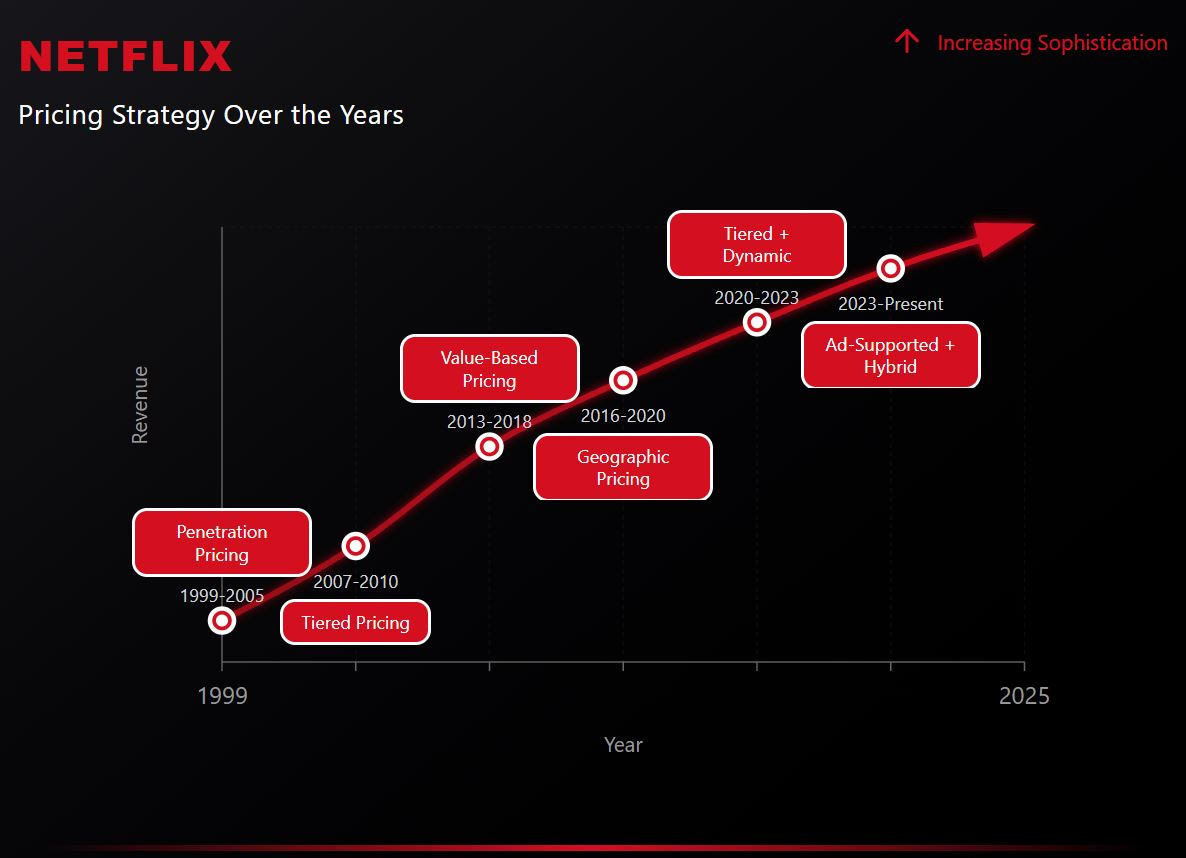
Stage 1: Penetration Pricing (Early 2000s)
It was David vs Goliath. Netflix vs Blockbuster.
To win this battle Netflix started undercutting Blockbuster’s fee-heavy model. Instead of charging per rental, Netflix offered a low flat monthly fee for unlimited DVDs delivered to your home with no late fees (a huge customer pain point).
Why it worked:
Removed friction (no late fees)
Price felt like a steal compared to renting multiple DVDs per month
It helped Netflix gain massive early adoption
Stage 2: Subscription Pricing (Mid 2000s)
Penetration pricing worked, and customers were hooked. New users were exploding. The pricing strategy then switched to long-term retention: how can we lock in customers to achieve steady, recurring revenue.
Netflix built loyalty and created “habit value.” Customers were able to justify to themselves their monthly subscriptions because it allowed them to watch unlimited movies at a set price.
Why it worked:
Smoothed out cash flow into a predictable model, making operations scalable
Customers continued to pay even when their usage dipped
Stage 3: Tiered Pricing (2010s)
As streaming took over and DVDs began to slowly disappear, this completely upended Netflix’s cost structure. Every HD stream and extra screen added more expenses from bandwidth and servers to expensive content licensing.
This is when Netflix introduced tiered pricing:
Basic: 1 screen, SD
Standard: 2 screens, HD
Premium: 4 screens, HD (later upgraded to 4k)
Stage 4: Geographic Pricing (Mid 2010s-Present)
When Netflix went global, charging the same $15 per month everywhere just wouldn’t work. That price would be huge in countries like India or Brazil.
Netflix adopted geographic pricing and adjusted subscription rates by market.
Why it worked:
Allowed Netflix to scale worldwide
Became affordable globally while still protecting margins in wealthier countries
Reduced piracy risk in countries where Netflix could have been seen as expensive
Stage 5: Value-Based Pricing (Late 2010s-Present)
Everybody was getting into streaming: HBO Max, Disney+, Prime Video. There was so much competition that Netflix couldn’t rely on convenience anymore.
This is when they leaned heavily into value-based pricing driven by offerings on the site and Netflix Originals (Stranger Things, Squid Game, Bridgerton, Money Heist, etc). By demonstrating they had superior and popular movie and TV show options, Netflix was able to continue to charge what they thought their subscription was worth to the consumer.
Peacock, Paramount, and even Apple TV continued to compete on price. Amazon took on the bundle pricing approach with Prime Video.
Why it worked:
Customers linked price to exclusive content
Retention stayed strong even as prices went up
Price hikes felt justified as they were tied to premium value
Stage 6: Hybrid & Dynamic Elements (2020s)
Netflix has continued to experiment with pricing strategies in recent years. They added account sharing fees, ad-supported tiers, and other tweaks. This approach has become a mix of both dynamic and segmentation pricing.
Why it worked:
Netflix continues to deliver record breaking revenues
Keeps price-sensitive users in the ecosystem
Captures other customers willingness to pay
Country-by-country experiments let Netflix test and optimize
My Takeaways and Advice
Netflix didn’t just stumble into the right pricing strategy. It became the most important experiment, adjusting it as their audience, competitors, and costs all evolved.
Throughout each stage of their journey, their pricing strategy represented their end goal and brand positioning:
Needed users → Penetration Pricing
Needed steady revenue → Subscription Model
Wanted to stand out → Value-Based Pricing
Scale globally → Geographic Pricing
Fine-tuning and margin improvement → Dynamic Pricing
Pricing is a system that should evolve and grow with the business. However, before you can experiment with one it is extremely important to understand your cost structure and brand positioning. How do they compare to your competitors? Do you offer more value, or do you compete on accessibility? Will any of these things change with scale? Once you know these things, you can design a pricing approach that not only attracts customers but also supports sustainable growth.
Thanks for reading. Hoping these write-ups are providing some value to you regardless of what stage you are at the in your entrepreneurship journey. I think constantly learning and thinking about problems from different perspectives is the best way to approach business and life in general.
Let me know in the comments if there are any particular topics you’d like me to cover. I have literally thousands of pages of class notes, personal research, and interviews with entrepreneurs.
Cheers.